NANOTECHNOLOGY AND GLOBALIZATION: THE NEW FRONTIER OF SCIENCE
Nanotechnology is the new frontier of science. This technology has applications in all existing and potential industries. Currently being implemented in industries as diverse as medicine, biology, environment, information technology, construction, ... The molecular nanotechnology is a new emerging science that involves the use of all types of nano-sized instruments (which is a size not much greater than that of atoms or molecules), which are not governed by the laws of conventional physics. These instruments are nanotechnology Nanoparticles, nanotubes, nano-robots, ... that may form nano-scale anything. You are almost unbelievable considering applications such as nano self-replication of molecules. All the precise definitions can be found at:
concepts of nanoscience's father, Richard Feynman, Nobel Laureate in Physics (1959), who in 1959 was proposed to manufacture products based on a rearrangement of atoms and molecules. In 1959, the great physicist wrote an article that examined how computers work with individual atoms could consume very little energy and achieve amazing speeds.
Faced with this new technology and its infinite applications, Charles Vest (former president of MIT), said "that nanotechnology will lead to a second industrial revolution in the twenty-first century." Vest
This assertion has some important implications as to the use of this technology in all fields of human knowledge has a potential and implications for the human being, in my humble opinion, is not ready yet . These implications, both social, and economic, political, etc. humans is not yet prepared to assume, as the technology gap may be unbridgeable technology gap, and would create tremendous social desilguades. Although it should be noted that the problem may be part of the solution, because in one case might be all you need to develop technology to an entire city.
Nanotechnology is a science, emerging but rapidly developing, and when the science is mature it will expand within a few years. The latest discoveries in this area are: desalination of sea water, sunscreen, new plastic material capable of attracting and repelling water, stroke and Alzheimer detector, clothes that fights toxins, new methods to diagnose cancer, molecular motors that start with chemical energy, ... amazing! In March 2004 researchers at Carnegie Mellon University created nanoparticles capable of cleaning contaminated sites and eliminate toxic elements pollution. Received wide media coverage. And in the book Engines of Creation, Drexler envisions nanobots capable of destroying cancer cells, collect radicals or repairing damage in the cell tissues.
At this point, we will analyze the benefits and risks of this science. Benefits are
every imaginable by anyone, once examined all fields of knowledge covered by this technology could solve water shortages, combat infectious diseases, supply all the world's energy and with minimal costs, reduce environmental impacts, You could make cheap equipment and advanced medical research and health, with much greater availability of advanced medicines, let endless applications.
risks, basically it could reduce the applications to give you the human being to this new technology. Hence, my idea that we must take great care with this technology. Faced with this new technology global applications must prepare before the changes. This preparation should act in all social, economic, judicial, psychological, ...
Before the industrial revolution (also in my opinion), in an increasingly globalized world, we need to act consciously and take advantage of all the advantages that we provide this technology.
Sunday, July 2, 2006

Dark Colored Stool After Drinking
LOW COST: NEW IBERIA BET
 companies low-cost airlines consist of a low cost of service utilization.
These companies have expanded throughout Europe in a short period of time. Currently operating in Spain 35 airlines, 15 European countries.
With 2003 data, Spain has received more than 10.5 million passengers on more than 78000 international flights. This year, the use of cheap flights grew around 34%, meaning that more than 2.8 million passengers shifted to airlines flights.
The graphs below show how they are equating the use of these companies in Spain:


This growth is that Spain is a destination within the preferences of European consumers, good weather, fun, inexpensive access to holiday homes (taking into account the purchasing power ),...
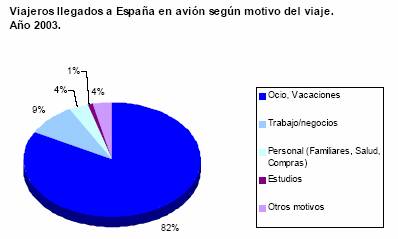
The success of these companies is, in reducing costs of these companies are reflected in smaller planes, less comfort, and reduced costs to buy a ticket online. What has been translated into economic terms that these companies are specialized in the segment of the demand for flights to lower-middle income, so that consumers could not use the plane (or, less frequently) now used by more . We see this reasoning in the following graph:

Then, before this change in preferences, the largest airline of Spain, has been left out of this market, with consequent loss of customers and profits. Iberia
reaction has been slow to manifest, last March 2006, the press office of Iberia has announced it will fight these low-cost companies, announcing that he will lower the price of the tickets to some European destinations. In conclusion of this release, see the reaction of Iberia in the price war emerged for the companies' low-cost, but Iberia triumph in this hostile market simply by lowering prices without creating a subsidiary, as have other European companies ... 
These companies have expanded throughout Europe in a short period of time. Currently operating in Spain 35 airlines, 15 European countries.
With 2003 data, Spain has received more than 10.5 million passengers on more than 78000 international flights. This year, the use of cheap flights grew around 34%, meaning that more than 2.8 million passengers shifted to airlines flights.
The graphs below show how they are equating the use of these companies in Spain:

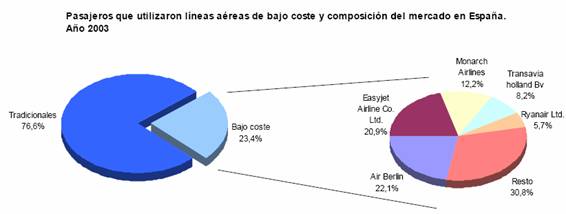
This growth is that Spain is a destination within the preferences of European consumers, good weather, fun, inexpensive access to holiday homes (taking into account the purchasing power ),...
The success of these companies is, in reducing costs of these companies are reflected in smaller planes, less comfort, and reduced costs to buy a ticket online. What has been translated into economic terms that these companies are specialized in the segment of the demand for flights to lower-middle income, so that consumers could not use the plane (or, less frequently) now used by more . We see this reasoning in the following graph:
Then, before this change in preferences, the largest airline of Spain, has been left out of this market, with consequent loss of customers and profits. Iberia
reaction has been slow to manifest, last March 2006, the press office of Iberia has announced it will fight these low-cost companies, announcing that he will lower the price of the tickets to some European destinations. In conclusion of this release, see the reaction of Iberia in the price war emerged for the companies' low-cost, but Iberia triumph in this hostile market simply by lowering prices without creating a subsidiary, as have other European companies ...
What Country Was Affected By Malaria In 2010
The new tool used in the company's Internet.
Given its great expansion and companies around the world are using or are already using Internet for various reasons. In this blog, we will analyze this phenomenon more or less recent.
Internet use by English companies, have increased in number as shown on the graph, you can see that when the larger company, the greater their use:

English SMEs are the percentage remains to be added to these statistics.
The role of Internet in business the Internet can be divided into corporate and commercial Internet.
corporate Internet is the use of the Internet for exclusively domestic. Can be a tool for instant communication via e-mail, FTP file transfer is a Web protocol for sending files instantly through the Web, Intranet to find corporate information, and the same Internet that can provide information on the industry to the company dedicated its activities, information about customers, competition. It can also be used for training Staff employed by the company, through e-learning "will comment on that is another blog.
commercial Internet, is to use the Internet to create a corporate Web-free access for all users who want it.
This type of website, and offer all types of customer services, is mainly used for "e-commerce", which is to capture leads, make sales held by the company, performing from the customer returns basically establish a feedback between the company and the customer.
Another factor to take into account the commercial Internet, is contextual advertising that can make a business. This contextual advertising is advertising on other Web sites through banners. These banners have a very low cost because it only pays for the user inserts through that banner.
Another issue to take into account is the positioning of the corporate Web. This position must be taken into account, as customers seek info9rmación products through search engines, and positioning your company determines whether before or after leaving the website of the competition.
The general conclusions we can take on the use of Internet by businesses, lead us to a company that makes proper use of Internet can accomplish a great and rapid growth and the possibility of expanding the market, so that the Internet should be considered a strategic variable in a company. Globalization
Can A Bearded Dragon Live With Any Other Lizard
INTERNET IN BUSINESS INFORMATION TECHNOLOGY : MAJOR ELEMENT OF GLOBALIZATION
 to discuss this phenomenon is to focus on variables that globalization has been developed.
This phenomenon is developing in all areas, but there are areas already developed. These areas are already globalized capital market, has also been globalized information (that promotes transparency), the skilled labor and technology. If technology had not been globalized, had become obsolete as happened in his day, with the technology of the USSR.
This globalization of technology began with the industrial revolution and the assimilation of the industrialized countries of different technology.
Today, technology has become the information technology, companies base their strategic policies on productivity and competitiveness, these variables are beginning to instrumentalize with information. Information systems, with advanced technology, good management skills and a good processing of it may lead to increased productivity and global competitiveness of large enterprises.
information technology, currently based on Internet is a global network of interconnected servers, where you can collect all the information stored on those servers. Applications and the Internet are endless boundaries, since apart from all the information contained on those servers (which today, it is unquantifiable), how to share, distribute, extract are very difficult to enumerate.
But an equally important issue is the communications revolution, which is the new area of \u200b\u200bglobalization, as the American sociologist "Giddens essence of globalization is constituted by the multinational oil corporations and the expansionary policies Bush administration, but its essence is defined by the "revolution communications "and that is something irreversible.
Information is being globalized by the phenomenon of communications, mobile telephony, Internet, email, blogs, satellite communications, ...
All these channels and many more could indicate which form of information technology.  s
s
This phenomenon is developing in all areas, but there are areas already developed. These areas are already globalized capital market, has also been globalized information (that promotes transparency), the skilled labor and technology. If technology had not been globalized, had become obsolete as happened in his day, with the technology of the USSR.
This globalization of technology began with the industrial revolution and the assimilation of the industrialized countries of different technology.
Today, technology has become the information technology, companies base their strategic policies on productivity and competitiveness, these variables are beginning to instrumentalize with information. Information systems, with advanced technology, good management skills and a good processing of it may lead to increased productivity and global competitiveness of large enterprises.
information technology, currently based on Internet is a global network of interconnected servers, where you can collect all the information stored on those servers. Applications and the Internet are endless boundaries, since apart from all the information contained on those servers (which today, it is unquantifiable), how to share, distribute, extract are very difficult to enumerate.
But an equally important issue is the communications revolution, which is the new area of \u200b\u200bglobalization, as the American sociologist "Giddens essence of globalization is constituted by the multinational oil corporations and the expansionary policies Bush administration, but its essence is defined by the "revolution communications "and that is something irreversible.
Information is being globalized by the phenomenon of communications, mobile telephony, Internet, email, blogs, satellite communications, ...
All these channels and many more could indicate which form of information technology.
Subscribe to:
Posts (Atom)